In early childhood education, special days and celebrations can be powerful opportunities for learning when they are intentionally planned.
Valentine’s Day, in particular, offers a meaningful context to support social development, peer awareness, and inclusion in childcare settings. Rather than focusing on the traditional idea of Valentine’s Day, educators can use this occasion to promote connection, cooperation, and shared experiences among children.
For many young children, learning how to interact with peers is an ongoing process. These skills develop gradually through structured experiences that are repeated in a safe and predictable environment. Valentine’s Day provides a natural theme to introduce activities centered on kindness, shared attention, and participation in group routines. These experiences are especially important for autistic children, who may experience social interaction differently and often benefit from clear structure, visual cues, and hands-on activities.
Social interaction does not require verbal communication. Actions such as participating in a shared task, taking turns, or engaging alongside others are all valid forms of interaction. When educators recognize and value these forms of communication, they create an inclusive environment where every child can succeed.
Supporting Autistic Children Through Intentional Planning
Autistic children may find unstructured social situations challenging. However, when interactions are embedded within predictable activities with clear steps, these children often engage more comfortably. Valentine’s Day activities can be designed to emphasize participation rather than performance, allowing children to interact at their own pace.
Providing choices, minimizing social pressure, and offering visual or physical cues can significantly improve engagement. Educators should focus on the process of interaction rather than the outcome. A child does not need to speak, make eye contact, or respond in a specific way for the interaction to be meaningful.
Activity 1: Collaborative Valentine Art Project
Purpose: To encourage shared attention, cooperation, and parallel interaction through a group art experience.
Materials:
- Large sheets of paper or poster board
- Paint, markers, sponges, or stamps in Valentine colours (red, pink, purple)
- Heart-shaped stencils or cut-outs
- Aprons and table covers
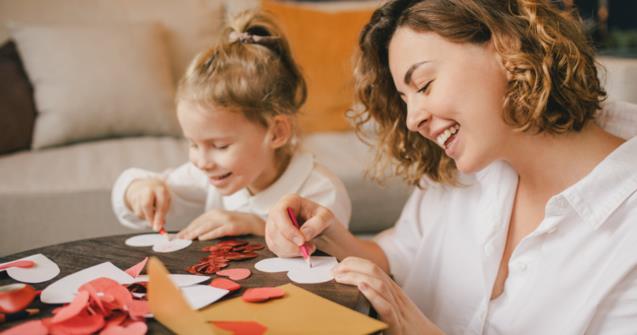
Description: Educators set up a large art surface that several children can work on at the same time. The goal is not to create individual art pieces, but to build one collective Valentine-themed artwork. Children are invited to add marks, colors, or shapes to the shared surface in any way they choose.
The educator models simple actions such as stamping a heart or painting a line, then invites children to join. There is no expectation of conversation or direct interaction between children. Simply working side by side on the same project creates opportunities for shared attention and awareness of others.
For autistic children, this activity supports interaction without requiring social initiation. The child participates in a common goal while maintaining personal space. The predictability of the task and the sensory input from the materials can be calming and engaging.
Adaptations:
- Offer limited material choices to avoid overstimulation.
- Allow children to step away and return as needed.
- Provide visual examples of simple actions (e.g., stamp, paint, wipe).
This activity promotes cooperation, tolerance of proximity, and engagement in a shared experience. It reinforces the idea that being part of a group does not require verbal communication.
Activity 2: Valentine Helper Roles
Purpose: To build social responsibility, peer awareness, and interaction through purposeful classroom roles.
Materials:
- Simple visual cards showing helper tasks
- Valentine-themed classroom materials (decorations, books, bins)
- A schedule or chart to display roles
Description: In the days leading up to Valentine’s Day, educators introduce special “Valentine Helper” roles. These roles involve simple tasks that benefit the group, such as setting out Valentine books, organizing craft materials, helping decorate the room, or carrying items from one area to another.
Each role is clearly defined using visuals and simple language. Children are invited to take on a role individually or with a peer. The educator guides the child through the task and acknowledges their contribution to the group.
For autistic children, helper roles provide a clear purpose for interaction. The focus is on completing a task rather than engaging socially, which can reduce anxiety. Interaction happens naturally through proximity, shared focus, and brief exchanges with educators or peers.
Adaptations:
- Offer one-step tasks with clear beginnings and endings.
- Pair the child with an adult or familiar peer.
- Repeat the same role across multiple days to build confidence.
Helper roles support self-esteem, inclusion, and social participation. They allow autistic children to interact with others in a meaningful and structured way, without pressure to communicate verbally.
Best Practices for Educators
- Value non-verbal and indirect forms of interaction.
- Use structure and routine to support participation.
- Focus on engagement rather than outcomes.
- Provide consistent expectations and visual support.
Valentine’s Day in childcare does not need to look the same for every child. What matters most is that each child has the opportunity to engage, connect, and be part of the group in a way that feels safe and supportive.
By Jennifer Geigel
 Home
Home Theme activities
 Babies and toddlers
 Arts and crafts
 Science
 Creative recipes
 Tips and tricks
 Extra activities
 Educ-TV






 Newsletter
  Online store
 Educatall club