 This theme is based on the NEW Canadian Food Guide.
It is a flavor-filled theme that helps children develop
healthy eating habits by learning that food contributes to good health. Here is a special resource on the
new Canadian Food Guide.
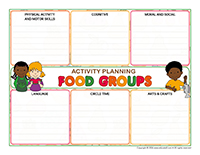
INTERACTIVE PLANNING-FOOD GROUPS
NEW! (Open interactive planning-Food groups) Print and use the document to present activities related to the theme for your group.
CIRCLE TIME
Puppets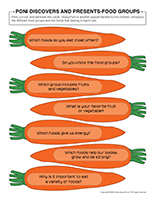
Use puppets for their “creative” aspect. Make them talk and interact with one another. Give children the opportunity to participate by letting their own puppets speak. You will find several puppet models in the educatout Club.
A treasure hunt to discover the theme
(Open educa-decorate-Food groups) Print and laminate the images. Hide them around the room. Ask the children to find the images and bring them back to the gathering area. Together, name the foods found. Help the children match each image to the correct food group.
NEW! Poni discovers and presents-Food groups
(Open Poni discovers and presents-Food groups) Print, cut out, and laminate the cards. Using Poni or another puppet familiar to the children, introduce the different food groups and the foods that belong to each one. Discussion prompts for circle time:
- Which foods do you eat most often?
- Do you know the food groups?
- Which group includes fruits and vegetables?
- What is your favorite fruit or vegetable?
- Which foods give us energy?
- Which foods help our bodies grow and be strong?
- Why is it important to eat a variety of foods?
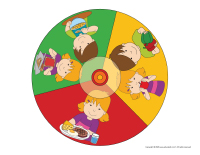
Interactive discussion-nutrition wheel
(Open nutrition wheel) Print, laminate, and cut out the two tabs. Make a small hole in the center of the wheel and insert a brass fastener to hold the spinner in place. To make the wheel sturdier, you can glue it to the bottom of a paper plate. Use the wheel as a trigger for discussion. Choose a child to spin the wheel. Ask the children questions to check their knowledge of the different food groups shown or the foods associated with each group.
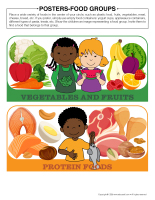
Place a wide variety of foods in the center of your circle, such as plastic food, fruits, vegetables, meat, cheese, bread, etc. If you prefer, simply use empty food containers: yogurt cups, applesauce containers, different types of pasta, treats, etc. Show the children an image representing a food group. (Open posters-Food groups) Invite them to find a food that belongs to that group.
Picnic Basket
To introduce your theme, place a large picnic basket on the floor in your childcare setting. Add plates, plastic food, water bottles, etc. Let the children handle everything. They will enjoy filling and emptying the basket over and over again.
AREA SETUP
NEW! Thematic poster-Food groups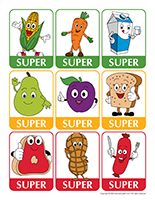
(Open thematic poster-Food groups) Print, laminate, and display where parents can easily see it.
NEW! Stickers-Food groups
(Open stickers-Food groups) Print the illustrations on adhesive paper and use them to create a collection of original stickers.
NEW! Educa-theme-Food groups
(Open educa-theme-Food groups) Print and laminate the different elements representing the theme. The items can be used to present the theme to children (and their parents) or simply to decorate your daycare for the theme.
NEW! Educa-decorate-Food groups
(Open educa-decorate-Food groups) Print, laminate, and cut out the items. Use them to decorate your daycare walls and set the mood for the theme.
 Integrate everything related to food into your room
Here are a few ideas: Place food items on shelves. Hang some from the ceiling and attach others to cupboard handles as well as in the cloakroom.Suggested materials for your thematic bin: Dishware set, plastic utensils, wooden spoons, cutting board, funnels, strainers, plastic food, cash register, food scale, fruit- or food-shaped stickers, refrigerator magnets, fruits and vegetables cut out of felt with Velcro on the back, play dough, scented markers, tablecloth, placemats, aprons, oven mitts, picnic blanket, chef’s hat, various empty food containers such as egg cartons, yogurt or applesauce containers, and small water bottles. Also add different types of pasta. Find various images in coloring books and laminate them. Print different fruits or vegetables on cardstock in various colors and laminate them or simply cover them with adhesive paper. These images can be used for sorting games (comparisons, matching by color, size, etc.).Haut du formulaireBas du formulaire
PICTURE GAME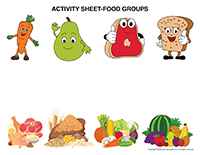
NEW! Picture game-Food groups
The pictures may be used as a memory game or to spark a conversation with your group. Use them to decorate the daycare or a specific thematic corner. (Open picture game-Food groups) Print, laminate, and store in a Ziploc bag or thematic bin.
Memory game-Food Groups
(Open picture game-Food groups) Print the cards twice and use them to play a traditional memory game.
ACTIVITY SHEETS AND WRITING ACTIVITIES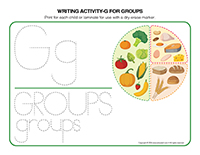
NEW! Activity sheets-Food groups
Activity sheets are suggested for each theme. (Open activity sheets-Food groups) Print and follow instructions.
NEW! WRITING ACTIVITY
(Open writing activities-G for groups) Print for each child or laminate for use with a dry-erase marker.
LANGUAGE ACTIVITIES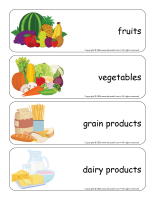
NEW! Word flashcards
The flashcards may be used to spark a conversation with your group, in your reading and writing area, or even to identify your thematic bins. (Open word flashcards-Food groups) (Open giant word flashcards-Food groups) fruits, vegetables, grain products, dairy products, proteins, whole grains, health, nutritionist, Guide, vitamins, water, exercise.
NEW! Educa-chatterbox-Food groups
(Open educa-chatterbox-Food groups) Print and laminate the items. Add them to a box that you have decorated to represent the theme. Add a variety of illustrations and objects related to the theme. During circle time or waiting periods, for example when children are waiting for their lunch to be served, encourage them to pick an item out of the box and name it.
Talk, Talk, Chat, Chat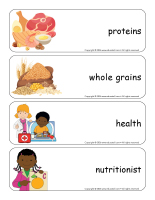
(Open word flashcards-Food groups) Print and laminate the word labels. Each child picks a word label. One at a time, they must present the image they picked. Talk with the children to see what they know about each image. Ask them questions related to fruits, vegetables, meat, grains, treats, milk, grocery stores, markets, restaurants, etc.
NEW! New Canadian food Guide
(Open new Canadian food guide) Print and laminate. Children take a food item from the bin one at a time and place it at the bottom of the correct poster. Ask the children whether they like the different foods.
Talking about food… with a puppet
Use a puppet to encourage children to talk about different topics related to food. The puppet may help shyer children overcome their embarrassment. It can also support children who need help with language development. One thing is certain: the puppet will make children want to talk!
NEW! Naming and sorting pretend foods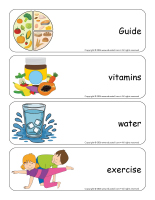
Fill a bin with plastic foods from the three food categories of the new Canadian Food Guide. (Open Food groups game) Print the posters (whole grain foods, protein foods, vegetables and fruits). Children take a food item from the bin one at a time and place it at the bottom of the correct poster. Ask the children whether they like the different foods.
NEW! I recognize the ingredients
Online or using old recipe books, find photos of recipes that contain the foods shown. (Open Food groups game) Print and laminate them. Show the recipes to the children one by one and ask them if they recognize any of the foods in the picture. For example, if you find a recipe for macaroni and cheese with broccoli, the children can take the images of pasta, cheese, and broccoli. Take the opportunity to have them name the foods and ask them, among other things, if they have ever eaten a similar recipe.
PHYSICAL ACTIVITY AND MOTOR SKILLS
NEW! Modeling dough activity placemats-Food groups
(Open modeling dough activity placemats-Food groups) Print and laminate. Let children pick a placemat and provide modeling dough. Encourage them to use the dough to fill or reproduce the shapes that are on their placemat.
NEW! Association game-Food groups
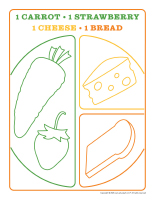
(Open association game-Food groups) Print, laminate, and cut out the game pieces. Place them on a table or on the floor. Cut out the foods. Invite the children to place each food in the correct spot on the tray, according to the number indicated. You can use a real baking sheet to make the game even more realistic.
Let’s Jump on food group elements
(Open educa-decorate-Food groups) Print, laminate, and attach the images to the floor. Play music. When the music stops, the children must sit on an element related to food groups, such as a plate, a meal, a snack, energy, health, or balance (musical chairs variation). This activity allows children to move while learning vocabulary related to healthy eating habits.
NEW! The Right Group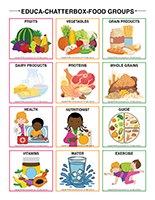
Take three paper grocery bags. Glue a poster representing one of the three groups on each bag, according to the Canadian Food Guide*. Add a fourth bag with a poster representing treats. Provide the children with foods (plastic or real) and invite them to place each one in the bag corresponding to the correct food group. We have prepared posters for you. (Open posters-Food groups) Print and glue them onto the bags.
Orange Juice to Strengthen Hand Muscles
You will need oranges cut in half, different types of citrus juicers (ideally with a spout), and glasses. First, invite the children to try squeezing the orange halves over the glasses using their hands. They will quickly notice it is difficult, but they will manage to extract a small amount of juice. Then provide the juicers for experimentation. The small movements required to extract the juice will strengthen their hands. They can then pour the juice into the glasses. Place a damp sponge on a plate so children can “clean” their fingers, as they will inevitably get sticky.
Sensory activity with spaghetti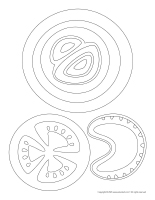
Cook a large quantity of spaghetti. Drain and place the pasta into several bins, ideally one per child. Add a little water if the spaghetti becomes too sticky. Place paper plates nearby, each containing a different color of tempera paint, and provide paintbrushes. Encourage children to paint the pasta however they like. A colorful sensory activity!
Our chopped salad
Place a large salad bowl in the center of the table. Provide green (lettuce), red (peppers), beige (croutons), and yellow (cheese) construction paper. Invite children to tear or cut the paper to represent salad ingredients and add them to the bowl. When it’s almost full, encourage them to toss the salad with salad utensils and serve portions into bowls or plates. Great fine-motor practice!
Food puzzles
Collect empty food boxes (cereal, crackers, bars, pasta, rice, etc.). Cut out only the front of each box, then cut them into pieces to create homemade puzzles (rectangles, squares, diagonals, zigzags, etc.). Adjust the number of pieces to the children’s ages.
Wrapped foods
Before the children arrive, wrap several plastic pretend foods in aluminum foil and place them in a bin. One at a time, children pick a wrapped item, feel it, and guess what it is before unwrapping. A great fine-motor activity.
NEW! Let’s toss our salad
(Open felt board-Food) Print the models and trace them multiple times onto felt (e.g., lettuce on green felt, tomatoes on red). Cut out the foods and place them on a parachute or large blanket. At your signal, children bounce everything as if tossing a giant salad. Then they can use the felt pieces to create individual salads in small bowls, using small plastic spoons.
NEW! Food dice
(Open dice game-Food) Print, laminate, and cut out the images. Attach them to the sides of a box covered with decorative paper. One at a time, children roll the die, name the food group shown, and then name foods that belong to that group. The game continues until the child runs out of ideas.
NEW! String activities-Food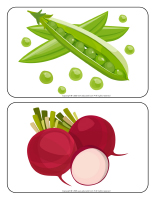
(Open string activities-Food) Print for each child. Children trace the outlines with white glue before covering them with colorful string.
Guessing basket
Place objects of various shapes and colors in a large basket. One at a time, children feel inside without looking and try to identify an object. They may ask two questions. If they succeed, they become the leader who answers questions for the next player.
NEW! Garden game
(Open garden game) Print six copies. Laminate and glue the illustrations on the floor so that children can hop on identical vegetables (from cabbage to cabbage for example). Name a vegetable. Children hop on the corresponding vegetable. When you name another vegetable, children must change their route. Variation: For a group of six children, use six illustrations of each vegetable. Play music. When the music stops, children must quickly stand on the vegetable you call out
Surprise box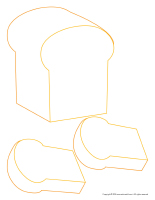
Wrap a box containing a surprise snack with many layers of tape. Sit in a circle with oven mitts in the center. Children roll a die; when someone rolls a 1, they put on the mitts and start unwrapping. Each time another child rolls a 1, they take over. The game ends when the box is fully unwrapped.
Watch out for the egg
Use two cups. Hide a hard-boiled egg (shell on) or a plastic egg under one cup. Children guess where it is. Add a third cup for variation.
Musical food
Sit in a circle. While music plays, pass a food item around. When the music stops, the child holding it keeps it. At the end, see who has the most fruits, vegetables, dairy products, etc.
Don’t drop the potato!
One child curls up and becomes a “potato sack.” Two or three children gently pull them by the legs to the storage area. Let everyone have a turn.
Food hunt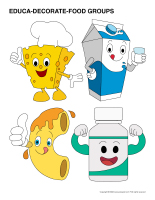
Hide photos or plastic foods in the room. Children collect only the foods belonging to the requested group (e.g., fruits only, vegetables only).
Egg carton sorting
Place many buttons in an egg carton. Children sort them by color, shape, number of holes, etc.
I’m going to the market…
Sitting in a large circle, sing: “When I go to the market, I put in my little basket…” naming a food. Each child repeats the previous foods and adds one. Using items from your thematic bin makes it easier for younger children.
Fruit salad game
Children are split into two teams facing each other with a ball in the middle. Assign fruit names to each player on both teams. When a fruit is called, the two players race to get the ball and return to their team to score a point.
Bakery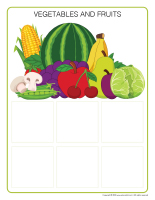
Turn the playdough area into a bakery. Provide playdough for cookies and cakes, a bin of flour, kitchen tools, small boxes, ribbons, and a shop corner for cooperative play.
Vegetable harvest
Hang many craft vegetables on tree branches with clothespins and invite children to harvest them.
Crunch! Crunch! Crunch!
Listen to the sounds your mouth can make. Encourage children to crunch different foods and listen to the sounds.
Water transfer
Set up bins of water with exploration tools: small spoons, measuring cups, funnels. Children transfer water between containers.
Necklaces
Provide pasta that can be threaded. Children make necklaces. You can color the pasta by shaking it in a bag with a few drops of paint, then letting it dry on a baking sheet.
COGNITIVE ACTIVITIES
NEW! Game-The four food groups
(Open game-Four food groups) Print, glue onto opaque cardboard, and cut out. Place all the cards face down on the floor. One at a time, children roll the die. Each time a child rolls a “1,” they turn over a card without showing it. If they do not already have that food group in front of them, they keep the card and place it face up. The game continues until a child has all four different food groups.
Homemade puzzles-Food groups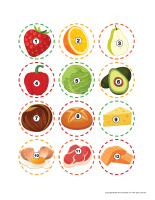
Use images related to food groups (meals, balanced plates, mealtimes, etc.) from flyers, books, or posters. Cut them into two or three pieces using decorative scissors. Give one piece to each child and hide the others. Children must find the missing pieces to complete their puzzle.
NEW! Educa-colors-Food groups
(Open educa-colors-Food groups) Print and laminate for long-term use. Children connect identical elements, then color the ones at the bottom so they match those at the top.
NEW! Educa-pairs-Food groups
(Open educa-pairs-Food groups) Print. Children connect identical images or color them the same color. For an eco-friendly option, laminate and use dry-erase markers.
NEW! Educa-symmetry-Food groups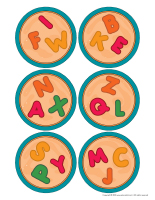
(Open educa-symmetry-Food groups) Print. Children must color the bottom picture (black and white) to make it look exactly like the top picture.
NEW! Food groups-Alphabet soup
(Open alphabet soup-Food groups) Print, laminate, and cut out the cards. Give each child a large bowl filled with water and a ladle. Place a bin of foam alphabet letters in the center of the table. Children draw a card and prepare their alphabet soup by adding, with the ladle, the letters shown on their card. Depending on the children’s ages, you may ask them to respect letter colors. Once finished, encourage them to name the letters (and colors, if desired).
Building with Boxes-Food groups
Provide empty food boxes and containers. Invite children to stack, line up, or place items according to simple instructions: on, under, beside.
NEW! Constructions to practice spatial concepts-Food groups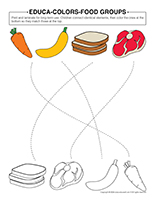
(Open constructions-Food groups) Print, laminate, and cut out the cards. Children reproduce the constructions shown using the correct number of boxes and cardboard food packages, practicing spatial concepts.
Measuring with blocks-Food groups
Present one package at a time. Children place blocks one by one to see which is taller or longer. Help them by counting the blocks together.
Rainbow colors
Show one color at a time. Children glue or point to images matching the color. The goal is color recognition, not perfect classification.
NEW! Counting pompoms-Food groups
(Open counting pompoms-Food groups) Print for each child. Children must press the correct number of pompoms on each item, per the indicated number.
Food groups race (calm version)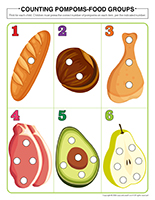
Hide only a few cards. Children walk to find them one at a time and place them in the center of the room. Together, name the food group shown on each card.
NEW! Food groups race
(Open playing cards-Food groups) Print and laminate the cards, then hide them indoors or outdoors. Divide children into two teams. At your signal, they must collect as many cards as possible within a set time (e.g., 3 minutes).
The four food groups (simplified)
Spread the cards so they are visible. Children choose a card one at a time and place it in front of them. The goal is to recognize food groups. There is no winner in this version.
NEW! Pick, search, and color letters-Food groups
(Open pick, search, and color letters-Food groups) Print and laminate the letters. Children pick a card and search for and color the corresponding letter.
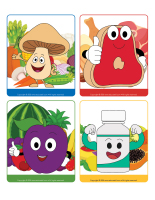
NEW! Educ-clothespins-Food
(Open educ-clothespins-Food) Print and laminate. Cut out the foods and glue each one onto a clothespin. Children clip healthy foods on the green side (child full of energy) and less healthy foods on the red side (tired child).
I Sort, group, and match
Use grocery items to help children sort and group objects by color, size, use, food group, etc.
Homemade puzzles-Food
Use food images (greeting cards, calendars, recipe books, etc.) and cut them into pieces. Give each child one piece and hide the others. Children must find the missing pieces.
NEW! Story and memory game-Food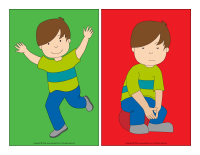
(Open story and memory game-Food) Print, cut out, and laminate. Place images face down. Children draw three cards and invent a story using the images. Tip: glue images onto frozen juice lids or print twice to create a memory game.
NEW! Meals game
(Open game-meals) Print and laminate. Using Velcro, children match foods to the correct meal.
Learning to measure
Fill a bin with rice. Add measuring cups, containers of various sizes, and utensils. Place elastic bands on containers to indicate fill levels. Once filled, children place them in increasing order. Great for pouring and measuring practice.
Setting my placemat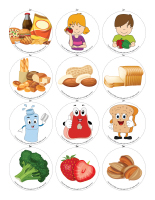
(Open place setting) Print one per child. Children color and laminate their placemat, learning how to set the table and recognize food groups.
It grows on a tree
Fill a bin with pretend foods, including many that grow on trees (apples, oranges, cherries, lemons, mangoes, coconuts, pears, peaches, limes, plums, bananas, etc.) and others that do not (meat, dairy, etc.). Draw a large tree outdoors. One by one, decide whether each food grows on a tree and place it accordingly.
Kitchen band
Provide pots, plastic containers, and utensils. Go outside and form a marching band in your neighborhood.
Watch out, I’m hungry!
One child is a very hungry ogre crawling on all fours. The others are healthy foods and must avoid being touched. When touched, they become ogres too. Continue until no food remains.
Orange, lemon, lime
Children move around outdoors. When you say “orange,” they walk fast; “lemon,” they walk slowly; “lime,” they freeze. You may also define a play area with a start and finish point.
MORAL AND SOCIAL ACTIVITIES
NEW! Photo booth-March nutrition month
(Open photo booth-Nutrition month) Print the accessory models, cut them out, and glue them on colorful drinking straws. At your local dollar store, purchase hats, headbands, scarves, glasses, etc. to complete your collection. Set up and decorate a corner in your daycare to represent a nutrition decor. Let children pick and choose their favorite accessories and photograph them. You can even encourage parents to take part in the fun! Print the pictures and display them on a wall for everyone to see.
NEW! Scrapbook-March nutrition month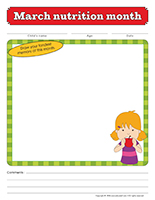
Print this new page for each child (Open scrapbook-March nutrition month) Have them complete the page and add it to their scrapbook.
ARTS & CRAFTS
My nutrition hat
(Open educa-decorate-Food) Print and cut out. Glue the shapes all around a hat or headband.
Broccoli footprint
Invite the children to remove one sock. Using a small roller, help them paint the bottom of their foot with green paint and press it onto cardstock. Let it dry. Then, attach green pom-poms on the toes to represent the florets.
Spaghetti painting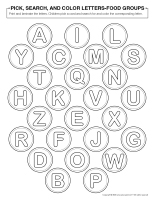
For each child, tie a handful of uncooked spaghetti together securely with butcher’s twine a few centimeters from one end. Bring a small pot of water to a boil. Place the spaghetti bundles vertically in the pot, leaving the tied end out of the water. Cook for a few minutes to soften only the submerged ends. Remove, drain, and let cool. Children can then paint using these unique brushes.
Crinkled paper foods
Print several black-and-white images of foods. Let children choose the food they prefer. Provide tissue paper for them to crumple and glue small pieces to fill in their chosen food.
Playdough foods
Provide playdough for children to sculpt different foods.
Stamps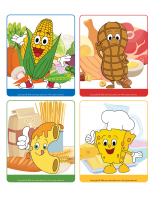
Cut foods in half lengthwise. Place these foods with paint or ink at the children’s disposal. They can use them as stamps and make impressions on paper.
My lunch bag
Each child receives a brown paper bag (lunch bag style). Place grocery flyers in the center of the table. Children glue the foods they would like to eat onto their bag. Return the bags to parents so they can see their child’s food preferences.
Spaghetti painting
Cook and drain spaghetti. Then dip in paint and use to paint on paper.
Observe and draw
Place an apple in the center of the table. Ask children to observe its shape and touch it. Provide drawing paper and colored pencils. Children then draw the apple.
COLORING PAGES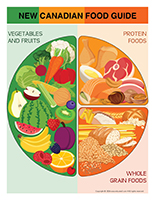
NEW! Coloring pages-Food groups
(Open coloring pages theme-Food groups) Print for each child.
Identical coloring-Food groups
Print a drawing for each child and one for your model. On the model, color only certain parts. Present it to the children and invite them to reproduce the same parts using the same colors to create an identical coloring page.
Colorable binder-Food groups
Laminate some coloring images and place them in a binder with dry-erase markers. Leave it available for children to use.
Musical drawing-Food groups
Play musical drawing. Give each child a drawing. Arrange children in a circle. While the music plays, children pass the drawings around. When the music stops, they color part of the drawing they are holding. Restart the music and continue passing the drawings around until complete.
Homemade puzzles-Food groups
Give each child a coloring page. Once colored, cut the drawings into pieces to create puzzles.
 Home
Home Theme activities
 Babies and toddlers
 Arts and crafts
 Science
 Creative recipes
 Tips and tricks
 Extra activities
 Educ-TV






 Newsletter
  Online store
 Educatall club